By Michael Howell
Nobody wants to come down with malaria. And, of course, nobody wants to come down with Ebola. But if you do get infected by the Ebola virus, you have a better chance of surviving it if you are also infected by the malaria causing Plasmodium parasite. Not only that, the greater the load of Plasmodium parasites in your system – that is, the worse your malaria infection – the greater your chances of surviving Ebola.
A few scientists at Rocky Mountain Laboratory in Hamilton were among the 40 scientists from around the world from a dozen different collaborating research groups who contributed to a recent study, published in the August 15 edition of Clinical Infectious Diseases, which shows that people infected with Ebola virus were more likely to survive if they were co-infected with malaria causing Plasmodium parasites.
Dr. Kyle Rosenke from the Laboratory of Virology, Division of Intramural Research at Rocky Mountain Laboratory in Hamilton, was one of three lead authors of the publication. Dr. Emmie de Witt, also from RML and a participant in the research and analysis, was available to comment on the study.
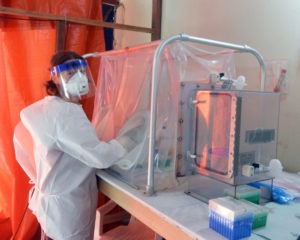
At a joint diagnostic laboratory established in Liberia by NIH and the Centers for Disease Control and Prevention, the scientists tested 1,868 blood samples. The samples were from people seeking care for possible Ebola virus infection at the ELWA3 Ebola Treatment Unit in Monrovia.
De Witt, who worked at the treatment unit in Monrovia, said that all patients were being administered an anti-malarial drug because the disease was endemic in the area and manifests many of the same symptoms as Ebola. Blood samples were taken from everyone admitted to the treatment unit and were tested for both the presence of Ebola virus and the Plasmodium species RNA.
According to de Witt, there was no time to do any further analysis during the crisis and no way of knowing who was going to survive and who would not when blood samples were taken, so no comparisons could be made. But in May of 2015, they began analyzing the data they did have and discovered the connection between the levels of Plasmodium parasites in the blood and the increased survival rates.
“The case fatality rate of 1182 patients with laboratory-confirmed Ebola virus infections was 52%. The probability of surviving decreased with increasing age and decreased with increasing Ebola viral load. Ebola virus–infected patients were 20% more likely to survive when Plasmodium species parasitemia was detected, even after controlling for Ebola viral load and age; those with the highest levels of parasitemia had a survival rate of 83%. This effect was independent of treatment with antimalarials, as this was provided to all patients. Moreover, treatment with antimalarials did not affect survival in the Ebola virus mouse model,” it states in the full report.
“Right now it is just an observation,” said de Witt. “We know there is a connection but we don’t know what it is. We don’t know the mechanism at work here.”
But recognizing that there is a connection, she said, can be an incentive to do the research that could determine the mechanisms involved and possibly lead to an effectual treatment. She was on her way last Wednesday to a conference at Colorado State University in Ft. Collins to give a talk on the subject.
The research group at RML is already working to pinpoint a mechanism that could explain the association of Plasmodium infection and surviving an Ebola infection. By giving mice both infections and studying the response, especially on the body’s immune system, a mechanism may be found that could improve our understanding of the disease caused by Ebola and open possibilities for developing new treatments.